Essential Home Studio Setup for Beat Makers on a Budget
# Essential Home Studio Setup for Beat Makers on a Budget
You do not need a million-dollar studio to make professional-sounding beats. Some of the biggest hits in recent years were produced in bedrooms and apartments with modest equipment. What matters is understanding the fundamentals of a good production environment and investing strategically in the gear that makes the biggest difference. Here is your complete guide to building a home studio on a budget.
The Computer: Your Central Hub
Your computer is the most important piece of gear in your studio. For beat making in FL Studio, Ableton, or Logic, you need at minimum 16 GB of RAM, a solid-state drive for fast sample loading, and a modern multi-core processor. Both Mac and PC work great. If you are on a tight budget, a well-specced Windows desktop gives you more power per dollar than any laptop. Prioritize RAM and storage speed over raw CPU power since most modern processors handle DAW work comfortably.
Audio Interface Selection
An audio interface converts your audio signals between analog and digital. For beat makers, you do not need dozens of inputs. A simple two-input interface handles a microphone and an instrument simultaneously. The Focusrite Scarlett Solo or 2i2, PreSonus AudioBox, and MOTU M2 are all excellent budget options. Look for low latency performance, quality preamps, and reliable driver support on your operating system.
Studio Monitors vs Headphones
Accurate monitoring is essential for making mixes that translate to other systems. Studio monitors like the Yamaha HS5, KRK Rokit 5, or JBL 305P provide flat frequency response for honest listening. However, if your room is untreated, headphones might actually give you more accurate results initially. The Audio-Technica ATH-M50x and Beyerdynamic DT 770 Pro are industry standards for closed-back monitoring. Ideally, use both and cross-reference your mixes between them.
MIDI Controller
A MIDI keyboard controller speeds up your workflow dramatically. Playing melodies and chords on a keyboard is faster and more expressive than clicking notes in a piano roll. A 25-key controller like the Akai MPK Mini or Arturia MiniLab fits small desks and covers most beat-making needs. If you play piano or want to learn, consider a 49 or 61-key controller for the full range. Drum pads on your controller are a bonus for programming rhythms intuitively.
Acoustic Treatment Basics
Your room acoustics affect what you hear more than your monitors do. Without treatment, you will hear exaggerated bass, flutter echoes, and inaccurate stereo imaging. Start with absorption panels at the first reflection points on your side walls and behind your monitors. Bass traps in the corners address low-frequency buildup. You can build effective panels cheaply using rigid fiberglass or rockwool wrapped in breathable fabric. Even hanging heavy blankets behind your listening position helps.
Desk and Ergonomics
You will spend countless hours at your production desk, so comfort matters. Your monitors should be at ear level, forming an equilateral triangle with your head. Your screen should be at eye level to prevent neck strain. Invest in a decent chair since back pain will end sessions early and limit your productivity. Your desk needs enough space for your controller, monitors, and computer without feeling cramped.
Software and Plugins
FL Studio is the industry standard for hip-hop and trap production with good reason. Its piano roll, mixer, and pattern-based workflow are intuitive for beat making. Start with the stock plugins before buying third-party options. FL Studio ships with excellent synthesizers like Sytrus and Harmor, quality effects, and a solid sample library. Learn these tools deeply before spending money on new plugins that you think will magically improve your sound.
Cables and Accessories
Budget for quality cables since cheap cables introduce noise and fail at the worst times. Get balanced TRS cables for your monitors, an XLR cable if you have a microphone, and a USB cable for your interface. A pop filter, microphone stand, and shock mount are necessary if you record vocals. Keep a pair of cable ties handy to manage your setup and prevent your workspace from becoming a tangled mess.
Building Over Time
Do not try to buy everything at once. Start with the essentials: computer, DAW, audio interface, and one monitoring source. Add gear as your skills develop and your income allows. Each addition should solve a specific problem in your workflow. The producer who masters a simple setup will always outperform the one who buys expensive gear without understanding the fundamentals.
Your Environment Matters
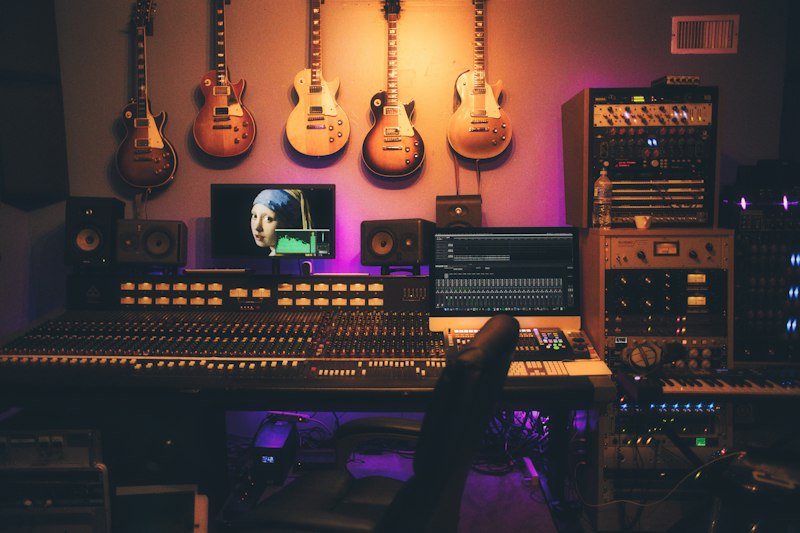
Keep your studio inspiring. Good lighting, clean organization, and a comfortable temperature make long sessions enjoyable. Some producers add LED strips for mood lighting during creative sessions. Others keep the space minimal and distraction-free. Whatever helps you get into a creative flow state, prioritize that in your studio design.